


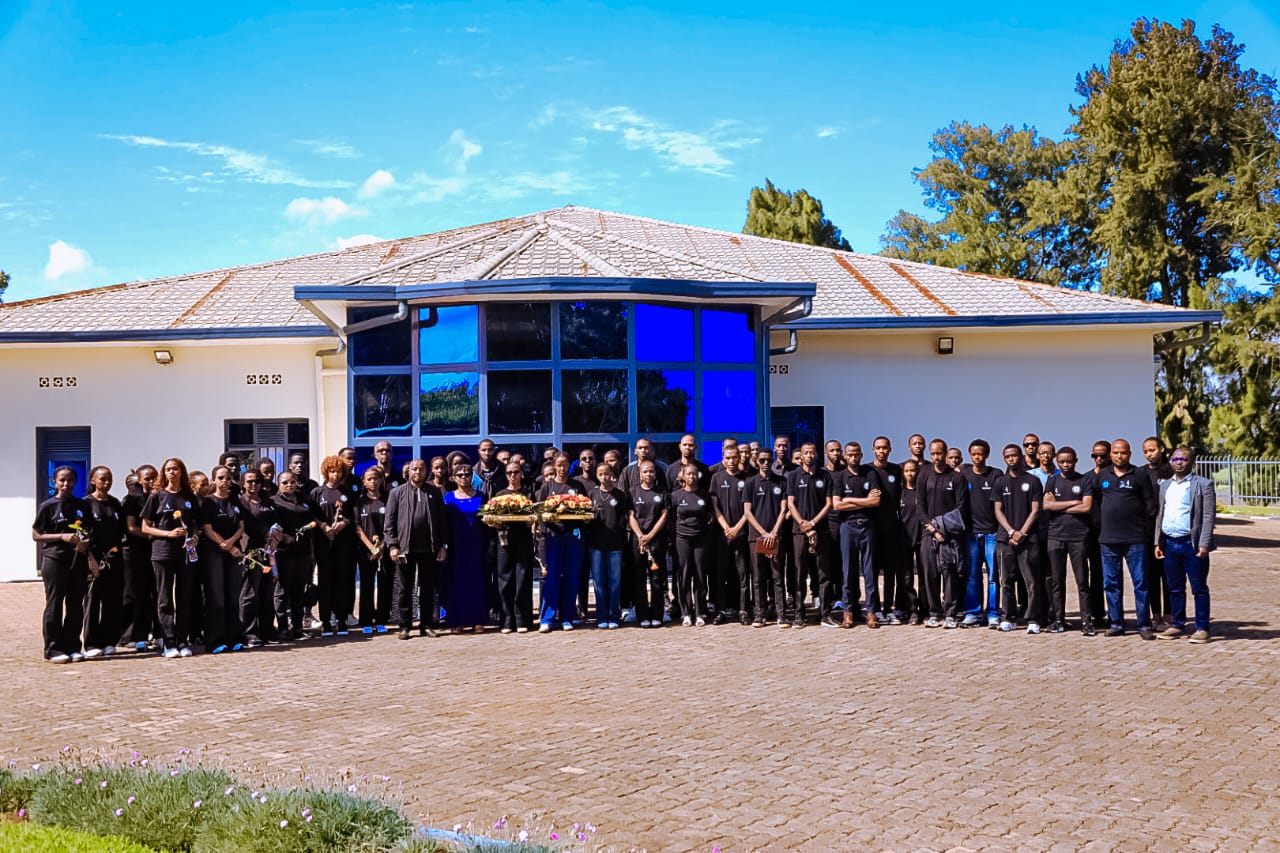
Students, lecturers, and staff representatives from the University of Rwanda’s Huye Campus have committed to taking the frontline in the fight against genocide ideology and online divisionism following a poignant visit to the Nyarushishi Genocide Memorial in Rusizi District.
The commemorative activity, which took place on May 29 as part of the 100 days of remembrance of the 1994 Genocide against the Tutsi, served as a powerful educational platform for the academic community to reflect on the country's tragic history and the imperative of unity.
Dr Pravda Mfurankunda, who led the university delegation, emphasized that honoring the victims is a fundamental institutional and constitutional responsibility.
"Every year, students, staff, and educators join the youth to remember the Genocide against the Tutsi. It is an occasion to reflect on the devastating consequences of bad leadership that planned and executed the Genocide, while also serving as a vital opportunity for the youth to learn how good leadership was subsequently established to champion the well-being of citizens," Dr Mfurankunda stated.
During the visit, the delegation was thoroughly briefed on the dark history of Nyarushishi. They learned how Tutsi who had sought refuge in the area were systematically killed, and how French troops deployed under Operation Turquoise allegedly enabled and supported the Interahamwe militia in the massacres.
The briefings also highlighted the heroism of the RPA Inkotanyi, who ultimately arrived to halt the killings and rescue the surviving refugees.
Today, the Nyarushishi Genocide Memorial is the final resting place for 8,559 victims. The site preserves stark historical evidence, including the clothing worn by the victims at the time of their murder, offering a visceral testament to the atrocities committed.
Confronted by this harrowing physical evidence, students expressed a renewed sense of duty to protect Rwanda's hard-won social fabric.
"We have learned so much," one student reflected. "Many of us were born after the Genocide and have mostly relied on the media or books to understand our history. But physically being here at the memorial, seeing where it happened, how the Tutsi were killed in 1994, how the international community abandoned Rwanda, and how survivors were rescued, provides a profound lesson in resilience, unity, and reconciliation."
Another student highlighted the specific battleground of the digital age, acknowledging the threat posed by those who misuse digital platforms to sow discord.
"As the youth, social media is an integral part of our daily lives," the student noted. "My primary responsibility now is to remain vigilant. When I see individuals spreading false information or hate speech, I must be the first to debunk those lies and present the factual truth."
The overarching message delivered to the academic community was a call to absolute self-reliance. Dr Mfurankunda urged the students to draw critical lessons from the international community's failure during Rwanda's darkest hour.
"This memorial teaches our youth that as a nation, we must look inward for solutions to build our country," Dr Mfurankunda added. "We cannot afford to be overly reliant on the international community, which often acts out of hidden self-interest rather than genuine compassion for our people."

Comments 0
Leave a Comment
No comments yet. Be the first to comment!